
A sheet metal surface can be marked, scratched, or bent long before it reaches the next operation. Sheet metal brush solutions are used to support material safely through punching, cutting, forming, conveying, and finishing processes while reducing metal-to-metal contact that can damage both parts and equipment.
For fabrication shops, OEMs, and maintenance teams, the right brush is not a minor accessory. Brush tables, panels, strip brushes, and roller brushes affect part quality, scrap rates, material flow, and machine uptime. The correct design depends on the machine, sheet size and weight, surface finish requirements, operating speed, and the type of debris present in the work area.
Where Sheet Metal Brush Solutions Are Used
Sheet metal processing creates several points where unsupported material can drag, vibrate, catch, or contact hard machine surfaces. CNC punch presses are a common example. Brush table panels support the sheet during loading and processing, helping prevent scratching on stainless steel, painted material, aluminum, galvanized sheet, and other finished surfaces.
Brushes are also used at machine infeed and outfeed points, on conveyors, around transfer systems, and inside equipment that moves blanks between workstations. In these applications, a brush may guide a part, cushion a contact point, remove light dust, or create a protective barrier between metal and equipment.
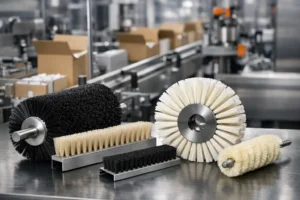
The application determines the brush style. A flat support surface may require brush panels or a brush table. A moving line may need cylindrical roller brushes. A gap that allows dust, chips, or light to enter may be better served by a strip brush. When a process requires more active surface cleaning, abrasive nylon or specialized filament configurations may be appropriate.
Brush Tables and Panels for CNC Punching
Brush table panels are manufactured for machines where sheet support and surface protection are critical. They are commonly specified for CNC punch presses from Amada, TRUMPF, Salvagnini, Prima Power, Murata, Finn-Power, LVD, Strippit, and similar equipment.
A replacement panel needs more than matching overall length and width. The panel must fit the machine bed correctly, align with mounting points, and provide suitable filament density and trim length for the material being processed. A panel that is too soft may not provide adequate support. One that is too stiff can create excess drag, interfere with sheet movement, or wear prematurely under heavy loads.
For maintenance departments, wear patterns provide useful clues. Flattened filaments, low spots, exposed panel bases, or frequent sheet marking indicate that a brush table should be inspected. Replacing individual worn sections before the entire table degrades can help protect finished material and prevent inconsistent handling across the machine bed.
Material Matters in Surface Protection
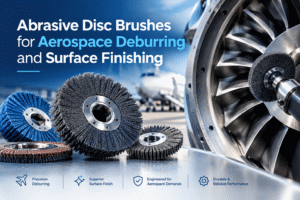
Nylon is a common choice for sheet support because it offers good wear resistance and recovery. However, nylon is not automatically the right answer for every operation. Polypropylene may be suitable where moisture resistance and a lighter-duty contact are priorities. Natural fiber can be considered for certain delicate finishing applications, while abrasive nylon is intended for controlled cleaning, deburring, or surface conditioning rather than passive material support.
Filament diameter also changes performance. Finer filaments create a denser, gentler contact surface and are often selected for cosmetic material. Larger diameters provide more stiffness and carrying support, but may be less suitable for highly polished or coated sheets. The right balance depends on part weight, finish sensitivity, and cycle conditions.
Selecting the Right Brush Configuration
Industrial buyers should start with the actual function the brush must perform. “We need replacement brushes” is a valid starting point, but it does not provide enough information to ensure a long-lasting fit. A brush designed for part support should be evaluated differently from one intended for sealing, debris control, or active cleaning.
For sheet metal handling, consider whether the brush must carry a stationary sheet, support a moving blank, control lateral movement, or protect a finished surface during transfer. The answer affects the base material, filament selection, brush density, trim length, and mounting method.
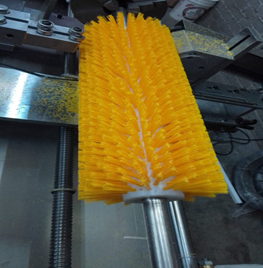
Cylindrical and roller brushes are often used where continuous movement is required. They can support or guide material across a conveyor or transfer point, but their core dimensions, shaft configuration, rotation speed, and bearing arrangement must match the equipment. Strip brushes are useful along edges, openings, guards, and machine transitions where a flexible contact line is needed.
Custom-engineered industrial brush solutions are particularly valuable when a standard catalog size does not match the equipment. This is common with older machinery, modified production lines, specialized OEM equipment, and machines that use nonstandard mounting patterns.
Design Factors That Affect Brush Life
Brush durability is driven by operating conditions as much as by the brush itself. A brush that performs well in a clean, dry fabrication environment may wear faster where sharp chips, oil, coolant, abrasive dust, or frequent impact are present.
Heat is another consideration. Some polymers soften or lose recovery at elevated temperatures, while certain applications require filaments that tolerate heat, chemicals, moisture, or washdown conditions. If the brush contacts freshly processed material or works near welding, curing, or high-friction zones, those conditions should be part of the specification.
Excessive brush wear can also indicate a machine issue. Misalignment, uneven loading, improper sheet entry, damaged supports, or incorrect pressure can destroy even a well-designed brush. When replacement intervals become unusually short, it is worth reviewing the equipment condition rather than simply ordering the same part again.
What to Provide for a Custom Quote
A detailed request reduces delays and improves the likelihood that the first brush design will fit and perform as intended. For replacement and custom brush solutions for production equipment, provide machine make and model, overall brush dimensions, mounting details, and photographs of the existing brush or installation area when available.
It also helps to describe the sheet material, thickness range, surface finish, process speed, operating temperature, and exposure to oil, coolant, dust, or chips. If the brush is failing, include the wear pattern and replacement frequency. That information helps determine whether the original material and geometry remain appropriate or should be improved.
For brush tables and panels, buyers should verify panel thickness, brush field dimensions, hole locations, fastener type, and the orientation of the brush rows. For roller brushes, confirm core diameter, face length, shaft or bore dimensions, and direction of rotation. Small dimensional errors can create fit problems that delay installation.
When Standard Replacements Are Not Enough
Standard replacement brushes work well when the equipment and application have not changed. But changes to material type, coating, part geometry, production speed, or machine configuration can justify a revised brush specification.
For example, a fabrication operation moving from unfinished carbon steel to prefinished stainless may need a softer, denser support surface to avoid cosmetic damage. A facility that increases throughput may need a more durable filament or modified brush density to maintain performance between planned maintenance intervals. An OEM may need a repeatable made-to-spec component that supports consistent machine performance across multiple installations.
Cepillos Regios manufactures brushes for demanding industrial applications with attention to machine fit, material selection, and real production conditions. The objective is not simply to duplicate a worn component. It is to supply a brush designed for durability, fit, and performance in the application where it will operate.
Frequently Asked Questions
How often should sheet metal brush panels be replaced?
Replacement timing depends on production volume, material weight, surface sensitivity, and brush wear. Inspect panels when filaments become permanently flattened, uneven, contaminated, or unable to keep sheet metal from contacting hard surfaces. A visible increase in scratches or inconsistent material movement is a practical warning sign.
Can a brush panel be made from a sample?
Yes. A sample, accurate dimensions, photographs, and machine information can be used to manufacture a compatible replacement. Providing operating details also allows the design to be reviewed for potential improvements in filament material, density, or trim length.
Are abrasive brushes appropriate for finished sheet metal?
Usually not for passive support applications. Abrasive nylon brushes are intended for controlled surface treatment, cleaning, or deburring. Finished, coated, polished, or cosmetic sheet metal typically requires nonabrasive filaments selected to protect the surface.
Need a custom industrial brush solution? Contact Cepillos Regios to request a quote based on your machine, dimensions, material, and application. A precise brush specification can help keep parts protected, equipment running, and maintenance planning under control.