
A brush that is off by a few millimeters can start causing problems long before anyone notices it on a purchase order. Parts drag, dust escapes, product finishes become inconsistent, and operators compensate for a poor fit in ways that increase wear elsewhere on the machine. That is why custom brushes vs stock is not a simple sourcing decision for manufacturers. It is a performance decision tied directly to uptime, quality, and replacement frequency.
For some applications, a stock brush is the right call. If the brush is used in a common size, on a standard machine, under predictable conditions, buying from existing dimensions can be efficient. But in many industrial environments, especially where brushes guide, seal, clean, support, polish, or protect moving product, standard sizes only solve part of the problem.
Custom brushes vs stock in real production settings
The main difference between custom and stock brushes is not whether one exists on a shelf and the other does not. The real difference is how closely the brush matches the machine, the material being processed, and the operating environment.
A stock brush is manufactured to common dimensions and common use cases. That can work well for general-purpose cleaning, basic strip sealing, or standard replacement needs where the equipment was designed around a widely available part. Procurement teams often prefer stock options when they need speed, simplified ordering, and a known part number.
A custom brush is designed around actual operating conditions. That includes the core size, trim length, filament type, density, mounting method, shaft or channel dimensions, RPM, contact pressure, exposure to heat or chemicals, and the surface being touched. In practical terms, that means the brush is built for the job instead of adapted to it.
This distinction matters most when the brush affects finished product quality, machine protection, or line reliability. In those cases, the cost of a mismatch usually exceeds the savings of buying a standard part.
When stock brushes make sense
Stock brushes have a clear place in industrial purchasing. They are often appropriate when the application is straightforward and the operating demands are moderate.
If a maintenance team is replacing a common wheel brush used for light cleaning, or a strip brush for a basic enclosure gap, a stock option may deliver acceptable performance without the lead time of a custom order. The same applies when a plant is standardizing around common replacement components across multiple facilities.
Stock brushes can also be useful for initial troubleshooting. If the goal is to test a brush style before committing to a more specialized configuration, an off-the-shelf option can help narrow down the right form factor.
The trade-off is that acceptable is not always efficient. A stock brush may fit the bracket but still miss the target in filament stiffness, density, trim, or wear life. It may work, but not as well as the application requires.
Where custom brushes earn their value
Custom-engineered industrial brush solutions become more valuable as the application becomes more specific. This is especially true in production lines where brushes are not incidental components but functional parts of the process.
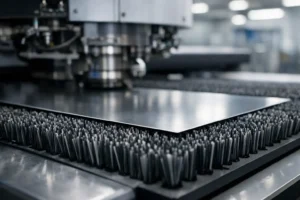
In CNC punch press tables, for example, brush panel height, density, and material directly affect sheet support, part movement, marking risk, and machine protection. A panel that is slightly off in height can change how material sits across the table. In a sealing application, a strip brush with the wrong filament diameter may leave gaps or create too much drag. In food processing or packaging, material compatibility and cleanability may be just as important as dimensional accuracy.
Custom brushes also make sense when replacement parts are no longer easy to source, when OEM dimensions have changed over time, or when a machine has been modified in the field. Many plants are running equipment that has been adjusted, repaired, or repurposed over the years. In those cases, catalog dimensions often do not reflect what is actually installed.
That is where a design-first process matters. Instead of choosing the closest available part, the buyer can request a custom quote based on machine, dimensions, material, and application. That changes the conversation from product availability to operational fit.
Cost is only one part of custom brushes vs stock
Buyers often begin with unit price, which is reasonable. But in industrial applications, the total cost of a brush includes more than purchase cost.
A lower-priced stock brush can become more expensive if it wears out faster, requires more frequent replacement, causes product damage, or contributes to downtime. If a brush is involved in conveying, sealing, deburring, or surface protection, even minor performance issues can affect scrap rates and maintenance hours.
A custom brush usually carries a higher upfront cost because it is manufactured for exact dimensions and operating conditions. But if it lasts longer, reduces changeouts, improves cleaning consistency, or protects the equipment better, the economics can shift quickly.
This is especially true in plants where downtime is measured in lost throughput rather than maintenance labor alone. For operations in automotive, steel, packaging, glass, wood, and other continuous production environments, a brush that fits correctly the first time often saves more than it costs.
Fit, material, and durability decide performance
The most common reason stock brushes underperform is not poor manufacturing. It is incomplete matching.
Industrial brush performance depends on several variables working together. Filament material affects chemical resistance, abrasion, heat tolerance, and contact behavior. Filament diameter influences stiffness and surface interaction. Fill density changes how aggressively or evenly the brush performs. Trim length affects flex and pressure. Core construction and mounting details determine stability at speed and compatibility with the machine.
A stock brush may match one or two of those variables and still miss the full requirement. A custom brush is designed to align them.
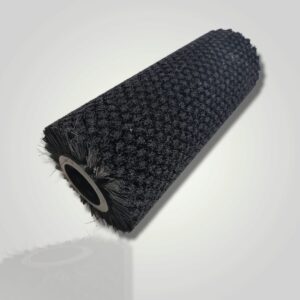
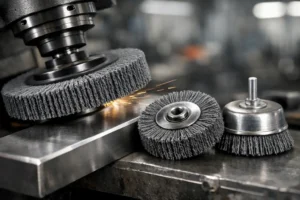
For example, abrasive nylon may be appropriate for surface treatment, but the grit, filament size, and brush construction still need to match the material being processed. A cylindrical brush used for cleaning or conveying may need a specific balance between softness and wear resistance. A sealing brush may require exact holder dimensions and filament recovery to maintain contact over time.
Designed for durability, fit, and performance means the brush is built around those variables from the start, not adjusted after purchase.
Lead time matters, but so does replacement accuracy
One reason buyers lean toward stock is urgency. When a line is down, available inventory has obvious appeal. But speed only helps if the replacement truly solves the problem.
Plants often lose time by ordering a standard part quickly, discovering fit or performance issues, then reordering a corrected version. That cycle is common with replacement and custom brush solutions for production equipment where dimensions were assumed rather than verified.
A responsive manufacturer can shorten that gap by reviewing machine details, confirming measurements, and producing a brush built for the actual application. Nearshore manufacturing can be especially useful for U.S. manufacturers that need dependable supply, practical lead times, and direct communication during specification.
In many cases, the better question is not stock or custom. It is whether the application can tolerate approximation.
How to decide between custom and stock
If the brush is used in a non-critical application, matches a known standard size, and has performed reliably as a catalog item, stock may be enough. That is a reasonable purchasing decision.
If the brush affects product finish, machine protection, dust control, part guidance, sealing, cleaning consistency, or wear life, custom is usually the better path. The same is true when the existing brush has recurring issues, when replacement intervals are too short, or when operators have had to compensate for poor performance.
For OEMs and engineering teams, custom design is often the better long-term option because it supports repeatability across machine builds. For maintenance and procurement teams, it reduces the risk of buying a part that fits on paper but not in service.
An experienced industrial brush manufacturer should be able to review the application and tell you honestly whether a stock configuration is sufficient or whether a made-to-spec brush is warranted. That kind of guidance is part of the value.
Cepillos Regios works with solutions for U.S. manufacturers and industrial operators who need industrial brushes manufactured for demanding industrial applications, whether the need is a standard replacement or a custom-engineered design.
What to provide when requesting a custom brush quote
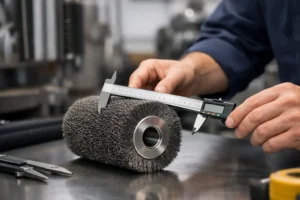
The fastest way to get the right brush is to provide the actual operating details. That usually includes brush type, overall dimensions, core or holder measurements, filament material if known, application purpose, machine model, speed, temperature, exposure conditions, and photos of the current part.
If the brush is failing early, that should be part of the request as well. Premature wear, inconsistent contact, marking, clogging, or poor sealing all point to design issues that may not be visible from dimensions alone.
The more complete the application data, the more accurately the brush can be manufactured for manufacturing, cleaning, sealing, and surface-treatment needs.
A practical way to think about this is simple. Stock brushes are useful when the job is standard. Custom brushes are the better choice when the job is specific, the tolerances matter, and downtime is expensive. If your brush is doing real work inside the process, not just sitting at the edge of it, it deserves the same level of specification as any other production component.