
A brush that looks close enough on paper can still fail quickly on the machine. Bristles wear too fast, the core traps debris, the strip backing does not seat correctly, or the brush applies too much or too little contact on the product surface. That is why an industrial brush specification guide matters. In production environments, the right brush is not just a replacement part. It is a fitted component that affects uptime, finish quality, sealing performance, and equipment protection.
For procurement teams, maintenance managers, and OEM engineers, the goal is simple: specify the brush correctly the first time. That means matching the brush design to the machine, the material being processed, the operating environment, and the expected service life. If one of those factors is off, the brush may still run, but not for long and not efficiently.
What an industrial brush specification guide should cover
A useful industrial brush specification guide starts with the application, not the catalog photo. The same general brush style can be used for cleaning, guiding, sealing, wiping, deburring, polishing, conveying, or surface protection, but each duty changes the specification.
A strip brush used to seal dust on a packaging line needs a different filament and density than a strip brush used to guide sheet metal. A cylindrical brush for washing produce requires different materials than a roller brush used in steel processing. Even when the brush geometry is similar, the operating conditions are not.
The core specification usually comes down to six factors: brush style, dimensions, filament material, filament trim and density, core or backing material, and mounting or drive requirements. The best specifications also include temperature, chemical exposure, moisture, speed, pressure, and the surface being contacted.
Start with the function before the brush type
The first question is not which brush do you need. The first question is what the brush must do.
If the brush must carry parts across a machine table without scratching finished surfaces, a brush table or brush panel may be appropriate. If it must scrub, wash, or apply material across a continuous width, a cylindrical or roller brush may be the better choice. If the purpose is to block dust, light, air, or overspray around doors, enclosures, or moving equipment, strip brushes and sealing brushes are usually the correct direction. For internal passage cleaning or tube and bore work, twisted brushes often make more sense.
This sounds basic, but many replacement orders begin with only a worn sample and a broad description. That creates risk. Two brushes can share similar outside dimensions and still perform very differently because the real design requirement is contact behavior, not appearance.
Common brush styles and where specification gets critical
Brush tables and brush panels are common on sheet processing equipment, including CNC punch press systems. Here, panel dimensions, hole pattern, brush height, filament stiffness, and abrasion resistance all affect part support and sheet movement. If the brush is too soft, the workpiece may drag or sag. If too stiff, the surface may mark.
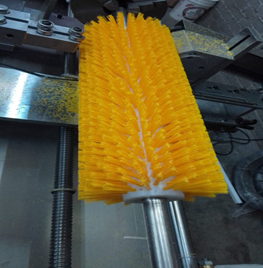
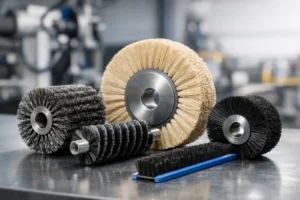
Cylindrical and roller brushes are highly application-dependent. Diameter, face length, shaft fit, balance, and rotational speed all matter. A brush built for low-speed sweeping is not the same as one built for continuous high-speed cleaning or product handling.
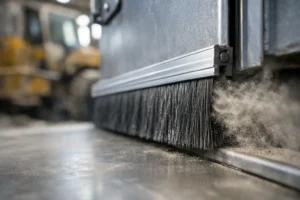
Strip brushes depend heavily on backing profile, channel fit, and trim. A mismatch in holder dimensions can turn a straightforward replacement into a field modification problem. In sealing applications, small dimensional errors can create light gaps, dust leakage, or excessive drag.
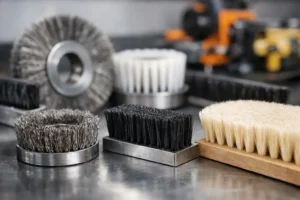
Wheel brushes and abrasive nylon brushes require even closer review because the contact force and abrasive grade directly affect the finish. In deburring and edge radiusing, aggressive filament can improve throughput but may also reduce part consistency or shorten brush life if the speed and pressure are not controlled.
Dimensions matter more than buyers expect
An industrial brush specification guide is incomplete without clear dimensional data. In custom and replacement industrial brush solutions, dimensions are often the difference between a quick installation and a shutdown delay.
For strip brushes, critical measurements include overall length, backing width and height, filament trim, and the way the brush mounts into the channel or holder. For cylindrical brushes, the outside diameter, core diameter, face length, shaft diameter, keyway details, and rotation direction may all be required. For brush panels and tables, panel size, brush height, tuft spacing, base construction, and machine model are typically necessary.
Tolerance also matters. If a brush is used in a loose guide application, a small variation may be acceptable. If it is part of a machine interface or a dust-control assembly, dimensional consistency becomes much more important. Buyers in automotive, packaging, food, and metal fabrication environments usually need to specify not just nominal size, but fit expectations.
Filament material selection drives performance
Material selection is where many brush specifications either succeed or fail. The right filament has to match the task, but it also has to survive the environment.
Nylon is widely used because it offers good wear resistance, flexibility, and broad application range. It is a practical choice for many cleaning, conveying, and general-purpose industrial applications. Polypropylene performs well in wet conditions and offers strong chemical resistance, making it useful in washdown or corrosive environments. Natural fiber can still be appropriate in certain light-duty or temperature-sensitive uses, but it is not the default for demanding industrial service.
Steel, stainless steel, brass, and abrasive nylon each serve more specialized roles. Metal filaments are often selected for aggressive cleaning, rust removal, deburring, or surface preparation, but they can also damage softer substrates if the brush is not tuned correctly. Abrasive nylon is effective for controlled finishing and edge work, yet grit size, filament diameter, and machine speed all affect the result.
The trade-off is simple. More aggressive material may improve cleaning or finishing rate, but it can also increase wear on parts, coatings, or the brush itself. Softer material may protect the product surface, but it may not hold up long enough in a high-cycle operation.
Density, trim, and stiffness change the result
Two brushes made from the same filament material can perform very differently if the fill density or trim length changes.
Shorter trim generally increases stiffness. Higher density often increases contact area and brushing action. Longer trim adds flexibility and can help when the brush needs to conform to irregular surfaces. None of these variables is automatically better. It depends on whether the application needs scrubbing force, surface protection, gentle guiding, or a controlled seal.
This is especially important in replacement and custom brush solutions for production equipment. A maintenance team may assume that matching the original diameter and filament type is enough, but if the trim length or packing density changed over time, the brush behavior changes too. That can affect conveyor tracking, wipe quality, dust containment, or part finish.
Operating conditions should be part of the specification
A brush specified without operating conditions is only half specified.
Temperature affects filament memory and wear. Moisture changes performance in some materials. Chemical exposure can degrade both filament and core. RPM, surface speed, pressure, and duty cycle all influence service life. So does the nature of the material being contacted. Fine dust, oil, metal fines, sharp edges, food residue, and abrasive particulate each create different wear patterns.
That is why experienced manufacturers ask more than part dimensions. They want to know where the brush runs, how many hours it operates, what surface it touches, whether it sees intermittent or continuous contact, and what problem the current brush is causing. A brush designed for durability, fit, and performance is built from those details.
When to request a custom specification
Standard brushes are useful when the application is straightforward and the fit is known. But many industrial environments are not standard for long.
If the existing brush wears out too quickly, marks the product, fails to seal effectively, or requires repeated field adjustments, a custom-engineered industrial brush solution is usually the better path. The same applies when dealing with OEM equipment, modified machinery, retrofit lines, or older production systems where original parts are difficult to source.
For U.S. manufacturers in regions like Texas, Illinois, Ohio, and Michigan, speed matters almost as much as specification accuracy. Waiting on a poorly defined replacement often leads to multiple revisions, rushed freight, and unnecessary downtime. A better approach is to provide the machine model, application details, measurements, operating environment, and photos of the mounting area or worn sample. That allows the manufacturer to recommend a brush built for the real conditions, not just the closest stock item.
A practical way to specify the right brush
If you are preparing a quote request, gather the machine make and model, overall dimensions, mounting details, current brush material if known, operating temperature, product being handled, and the specific task the brush performs. If the current brush is failing, document how it is failing. Bent filament, rapid wear, poor sealing, product marking, or uneven contact each point to a different correction.
For many buyers, this is where a manufacturing partner adds value. A technical brush supplier should help refine the specification, flag risk areas, and recommend changes when the original design is no longer the best fit. Cepillos Regios works this way with custom-engineered industrial brush solutions manufactured for demanding industrial applications, especially when equipment uptime and replacement accuracy are priorities.
The right brush specification does not need to be complicated, but it does need to be complete. When the brush matches the machine, the material, and the duty cycle, it stops being a frequent maintenance issue and starts doing what it should have done from the start – support production without getting in the way.
Need a custom industrial brush solution? Request a custom quote based on your machine, dimensions, material, and application.