
A brush can fit the shaft, match the drawing, and still underperform because the filament is wrong for the work. Effective brush filament selection starts with the contact between the bristle and the product, belt, sheet, roll, or machine surface. That contact determines cleaning force, scratch risk, chemical resistance, heat tolerance, brush life, and ultimately whether a production line stays on schedule.
For industrial buyers, the right question is not simply, “What bristle material do we use?” It is: What must this brush do at operating speed, against this surface, in this environment, for this expected service interval? The answer may lead to nylon, polypropylene, abrasive nylon, natural fiber, wire, or a custom combination. Each material has a place, and each involves trade-offs.
Start Brush Filament Selection With the Application
Filament should be selected after defining the brush function and machine conditions. A cylindrical brush used to remove light dust from a packaging line requires a different design than a roller brush deburring stamped steel, a strip brush sealing an enclosure, or a brush table supporting sheet metal in a CNC punch press.
Begin with the material being contacted. Stainless steel, aluminum, glass, coated sheet, wood, textiles, food products, and plastic films respond very differently to brush pressure and filament stiffness. A filament that cleans carbon steel effectively may mark aluminum. A stiff bristle that removes debris from a conveyor may damage a painted or coated product.
The operating environment matters just as much. Heat, moisture, oils, solvents, cutting fluids, food-processing washdown, abrasive dust, and ultraviolet exposure can shorten filament life or change performance. Brush speed, direction of rotation, contact pressure, and dwell time also affect results. A brush that performs well in a low-speed manual station can fail quickly in continuous automated production.
A useful specification identifies the job in measurable terms: remove loose debris, apply a controlled wiping action, create a surface finish, seal a gap, guide a part, support a workpiece, or prevent product damage. Once the required function is clear, material, diameter, trim length, density, and brush construction can be engineered around it.
Common Filament Materials and Their Trade-Offs
Nylon for wear resistance and recovery
Nylon is widely used in industrial brushes because it offers good abrasion resistance, flexibility, and bend recovery. It is a practical choice for cleaning, conveying, light surface contact, parts handling, and applications where the brush must maintain its shape through repeated use.
Nylon is available in different grades and diameters, so it can be tuned from relatively soft contact to firm scrubbing. It is also a common base for abrasive nylon filaments. However, standard nylon can absorb moisture, which may affect stiffness and dimensions in wet environments. High temperatures and certain chemicals should be evaluated before specifying it for continuous-duty equipment.
Polypropylene for wet and chemical environments
Polypropylene is often selected for wet cleaning, washdown, chemical exposure, and many food-related applications because it has low moisture absorption and good resistance to a range of chemicals. It is also lighter and generally more economical than nylon.
The trade-off is lower heat resistance and less wear resistance in demanding abrasive work. Polypropylene can be an efficient solution for a sanitation brush or liquid-handling application, but it is usually not the first choice for aggressive deburring, high-temperature contact, or long service life against rough metal surfaces.
Polyester for stability in demanding conditions
Polyester offers strong moisture resistance and good dimensional stability. It is useful where humidity, washdown, or changing environmental conditions make nylon less predictable. It can also provide a useful balance of stiffness and durability for industrial cleaning and processing equipment.
As with any synthetic filament, the correct grade and diameter matter. A brush with polyester filaments may need a different trim length or fill density than a nylon version to deliver the same working face and contact force.
Abrasive nylon for controlled finishing and deburring
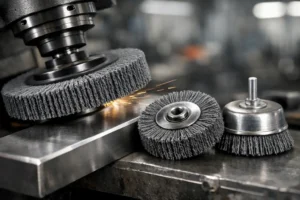
Abrasive nylon combines nylon filament with embedded abrasive grains, commonly silicon carbide or aluminum oxide. It is designed for surface-treatment tasks such as deburring, cleaning oxidation, blending finishes, and preparing metal surfaces.
The grain type, grit size, filament diameter, and brush configuration must be matched carefully to the required finish. More aggressive abrasive filaments can reduce cycle time, but they may also remove too much material, alter sharp edges, or create an inconsistent finish if pressure and speed are not controlled. For stamped, machined, or laser-cut parts, a sample test is often the most reliable way to confirm the specification.
Wire filaments for aggressive work
Steel, stainless steel, brass, and other wire filaments are used when a polymer filament does not provide enough cutting action. Wire brushes are common for rust removal, weld cleaning, scale removal, heavy deburring, and surface preparation.
Wire type is critical. Carbon steel wire can be effective for heavy-duty cleaning but may leave ferrous contamination on stainless steel or aluminum. Stainless wire is often preferred where corrosion resistance or contamination control matters. Brass wire offers a softer action for certain surfaces but is not a substitute for stainless steel in every application. Wire diameter, crimp, knotting, and brush speed all affect aggressiveness.
Natural fibers for gentle contact
Natural fibers such as tampico are used when gentle wiping, dusting, polishing, or static-sensitive handling is needed. These materials can work well in specialized finishing and light-cleaning applications, particularly where a softer contact is more important than long wear life.
Natural fiber is not the default choice for harsh chemicals, saturated washdown, or abrasive production conditions. Its performance depends heavily on the environment and the consistency required by the process.
Diameter, Trim Length, and Density Change the Result
Material alone does not define brush performance. Filament diameter is one of the main controls for stiffness. A larger diameter generally creates a stiffer, more aggressive brushing action, while a smaller diameter provides a softer, more conforming contact. This is why two brushes made from the same nylon can perform very differently.
Trim length also changes how the filament behaves. Longer trim is more flexible and can reach irregular surfaces, but it may deflect too easily under load. Shorter trim increases stiffness and contact force, but excessive stiffness can accelerate filament fatigue, mark the workpiece, or overload the brush drive.
Fill density affects coverage and force distribution. A dense brush face provides more contact points and can improve cleaning consistency. It can also retain debris, increase drag, and require more motor torque. Lower density may be better for drainage, product flow, or applications where the brush needs to flex around a profile.
For strip brushes and sealing brushes, filament orientation and packing are especially important. The goal may be to close a gap without creating excessive friction. For brush tables and brush panels, the objective is often controlled support that prevents scratching while allowing sheet movement across the machine bed.
Match Filament to Industrial Conditions
A practical brush specification should account for the full operating window, not only the immediate task. Maintenance teams should document temperatures, exposure to oils or cleaners, rotational speed, expected contact pressure, production hours, and the condition of the surface being processed.
For example, a brush panel for a TRUMPF, Amada, Salvagnini, Prima Power, Murata, Finn-Power, LVD, or Strippit punching machine must protect sheet material while fitting the table geometry and operating with repeated part movement. The wrong filament stiffness can contribute to scratches, poor support, premature wear, or inconsistent material handling.
In food processing, material compatibility and sanitation requirements may move polypropylene or selected polyester options ahead of a general-purpose nylon. In steel service centers and metal fabrication, abrasive nylon or wire may be required for cleaning and finishing, but the brush design must prevent unnecessary wear on valuable surfaces. In packaging and conveyor systems, a softer synthetic filament may provide the needed debris removal without damaging films, labels, or product surfaces.
Information to Provide for a Custom Brush Quote
A custom-engineered industrial brush solution begins with accurate application details. When requesting a quote, provide the brush type, overall dimensions, core or channel material, mounting method, filament material if known, filament diameter, trim length, and required quantity. Photos of the existing brush, machine location, worn filament, and mounting features can reduce guesswork.
Also describe what is not working with the current brush. Is it wearing too quickly, scratching product, leaving debris behind, losing stiffness, shedding filaments, or failing to fit the machine correctly? That information often matters more than a part number alone because it helps identify whether the original specification should be duplicated or improved.
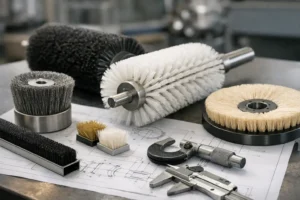
Cepillos Regios manufactures replacement and custom brush solutions for production equipment, including brush tables, brush panels, cylindrical brushes, roller brushes, strip brushes, wheel brushes, twisted brushes, and abrasive nylon brushes. The objective is not just to supply a replacement part, but to manufacture a brush designed for durability, fit, and performance in the actual operating environment.
Frequently Asked Questions
How do I know if a brush filament is too aggressive?
Common signs include scratches, unwanted surface removal, excessive heat, high motor load, damaged coatings, and rapid wear on the part or equipment. Reducing filament diameter, increasing trim length, changing material, or lowering abrasive grit may provide a more controlled action.
Can a worn brush be copied exactly?
Yes, but an exact copy is not always the best answer. If the previous brush failed prematurely or created quality issues, the replacement should be reviewed for material, density, trim, core design, and mounting improvements.
When should abrasive nylon replace wire?
Abrasive nylon is often appropriate when a controlled finish, edge conditioning, or consistent deburring action is needed. Wire is generally better for heavier scale, rust, weld residue, and more aggressive material removal. The part material and finish requirement should decide the choice.
The most reliable filament choice is the one that supports the required process without creating a new maintenance or quality problem. Need a custom industrial brush solution? Contact Cepillos Regios to request a custom quote based on your machine, dimensions, material, and application.