
Wood processing problems often show up first at the brush. A line starts leaving inconsistent finishes, dust control gets worse, edges are not cleaned properly, or parts begin marking during transport. In many of these cases, the issue is not whether you need brushes for wood, but whether the brush design actually matches the machine, the material, and the production conditions.
In industrial wood applications, brushes do more than clean a surface. They can guide panels, remove dust, texture grain, apply coatings, seal machine openings, protect finished parts, or support sanding and finishing operations. That is why brush selection should be treated as an equipment decision, not a commodity purchase. The right brush improves finish consistency and uptime. The wrong one wears early, damages product surfaces, or creates avoidable maintenance work.
Where brushes for wood are used
Wood manufacturing uses a wide range of brush configurations because the tasks vary so much from one process to another. A brush used to remove fine sanding dust from cabinet components is not built the same way as a brush used to texture flooring, protect panels on a conveyor, or seal dust around a machine opening.
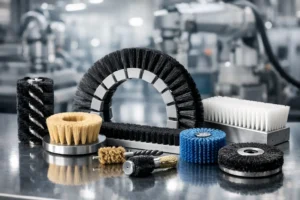
In most production environments, brushes for wood fall into a few practical categories. Roller and cylindrical brushes are common for cleaning, finishing, guiding, and coating-related processes. Strip brushes are often used for sealing, dust control, edge guidance, and machine protection. Wheel brushes can be used for deburring, edge work, or targeted surface treatment. Brush tables and brush panels are also relevant where wooden panels or components need low-friction support while moving through cutting, routing, or handling equipment.
The application drives everything. If the brush contacts a finished surface, filament choice and stiffness become critical. If it works in a dusty enclosure, sealing performance and wear resistance matter more. If it is part of a finishing or texturing process, consistency across the full face of the brush is essential.
Start with the application, not the catalog
One of the most common sourcing mistakes is choosing a brush style first and then trying to make it fit the job. In practice, industrial brush selection works better in the opposite direction. Define the task clearly, then match the construction to that task.
For wood applications, ask what the brush must actually do. Is it removing chips, sweeping fine dust, opening wood grain, applying pressure without marring, or protecting material during transfer? The answer affects filament diameter, trim length, density, core construction, and overall brush geometry.
Surface condition matters just as much. Raw lumber, MDF, plywood, veneer, laminated boards, and prefinished panels all respond differently to brush contact. A brush that performs well on unfinished hardwood may be too aggressive for coated components. That is where a custom-engineered industrial brush solution often makes more sense than a standard replacement selected by visual similarity alone.
Filament material makes a measurable difference
When buyers compare brushes, they often focus on dimensions first. Dimensions are important, but filament material has just as much impact on performance.
Nylon for general cleaning and finishing
Nylon is widely used in wood applications because it offers good wear resistance, flexibility, and reliable performance across many cleaning and finishing tasks. It is often a strong option when the goal is dust removal, light scrubbing, or controlled surface contact without excessive aggression. Nylon also handles repeated use well in demanding industrial applications.
Abrasive nylon for surface preparation
Abrasive nylon is used when the brush needs to do more than move debris. It can be effective for denibbing, edge breaking, surface conditioning, and texture-related processes. The trade-off is that abrasive filament must be matched carefully to the wood species, finish requirements, and line speed. Too aggressive, and it changes the part beyond spec. Too soft, and it does not produce the intended result.
Polypropylene and other synthetic options
In wet or chemically exposed environments, polypropylene or other synthetic materials may be a better fit. These can work well where moisture resistance is important or where the brush is part of a washdown-related process. The limitation is that not every synthetic gives the same recovery, stiffness, or wear life as nylon, so material choice should be tied directly to operating conditions.
Natural fiber and mixed-fill constructions
Some applications benefit from softer contact or a specific finish effect, which can make natural fibers or mixed-fill brushes useful. These are more application-specific and tend to be selected when the surface requirement is highly particular. In wood processing, that usually means the final appearance matters as much as throughput.
Stiffness, density, and trim length affect performance
Two brushes can have the same outside dimensions and still perform very differently. That difference often comes down to filament stiffness, fill density, and trim length.
Shorter trim generally increases brush aggression because the filament has less deflection. Higher density can improve contact consistency, but it also changes airflow, debris movement, and drag. A denser brush is not automatically better. In dust removal, for example, too much density can reduce the brush’s ability to release material efficiently. In surface treatment, insufficient density may create uneven results.
This is why machine speed and contact pressure should be considered early. A brush running at high RPM on a wide production line needs a different construction than one working slowly on narrow components. The production target matters too. If you are trying to maximize throughput, the brush must maintain performance over long runs without rapid filament fatigue.
Machine fit is just as important as brush material
A well-selected brush can still fail if it does not fit the machine correctly. For industrial buyers, that means replacement and custom brush solutions for production equipment should be specified with more than just overall length and diameter.
Mounting style, shaft size, core material, rotation direction, operating speed, and exposure to heat, dust, or moisture all affect service life. In roller and cylindrical brushes, balance and concentricity also matter. Poor fit can create vibration, uneven wear, and inconsistent contact across the workpiece.
For sealing and dust-control applications, strip brush dimensions must be aligned with gap size, mounting channel, and the actual movement of the material or machine component. A brush that looks adequate on paper may fail if the opening changes under vibration or if product thickness varies more than expected.
This is where many U.S. manufacturers benefit from working with a supplier that builds from machine measurements and operating conditions rather than offering a generic substitute.
When a standard brush works and when custom is the better choice
Standard brushes have a place. If the application is simple, the dimensions are common, and the process is not especially sensitive, a catalog-based replacement may be enough.
But wood manufacturing often includes variables that make custom design the safer choice. Surface sensitivity, part variation, fine dust, finish requirements, and machine-specific mounting details all push the application beyond standard assumptions. A custom brush may be needed if the current brush wears too fast, leaves marks, misses debris, causes inconsistent texture, or does not fit the machine exactly.
Custom-engineered industrial brush solutions are also useful when a plant is trying to solve a recurring problem rather than just replace a worn part. That might include reducing dust escape around a sanding station, improving finish consistency on a line with varying board widths, or increasing brush life in a high-cycle operation.
What to provide when requesting a quote
A faster quote usually starts with better application details. For brushes for wood, the most useful information includes brush type, dimensions, core or holder details, filament material if known, wood product being processed, machine model, operating speed, and the exact job the brush performs.
Photos of the existing brush and the machine are often helpful, especially when the issue involves fit or wear pattern. If the current brush is failing, explain how it is failing. Early wear, surface marking, poor cleaning, and uneven contact point to different design changes.
For OEMs, maintenance teams, and procurement departments, this level of detail shortens the back-and-forth and improves the chances of getting a brush designed for durability, fit, and performance.
Choosing a brush partner, not just a part supplier
Industrial brush sourcing for wood applications is rarely just about unit price. Downtime, scrap, inconsistent finish quality, and frequent replacement usually cost more than the difference between a generic brush and one built for the actual process.
An experienced manufacturer should be able to discuss filament selection, machine compatibility, wear expectations, and trade-offs. In some cases, a softer brush protects the surface better but wears faster. In others, a more aggressive filament improves cleaning but risks changing the finish. Those decisions should be made with the process in mind, not guessed after installation.
For manufacturers in Texas, Illinois, Ohio, Michigan, and other production-heavy regions, responsive supply and accurate replacement support are often just as important as brush construction. When a brush is part of a critical line, lead time and technical fit directly affect uptime.
Cepillos Regios manufactures custom and replacement brush solutions for production equipment, including designs built for manufacturing, cleaning, sealing, and surface-treatment needs. If your current wood-process brush is wearing early, marking material, or underperforming, request a custom quote based on your machine, dimensions, material, and application.
The right brush should quietly do its job shift after shift. If it keeps demanding attention, it is probably time to rethink the design.