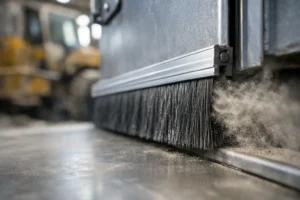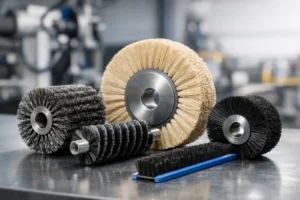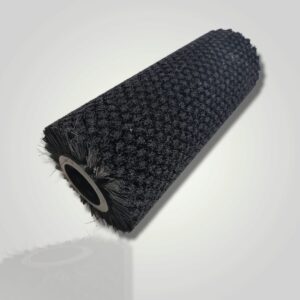

A conveyor line usually tells you what is wrong before anyone opens a maintenance ticket. Product starts drifting. Dust builds up at transfer points. Parts stop indexing cleanly. Belts carry fines where they should not, and operators begin making small adjustments to compensate. In many of these cases, cylindrical brushes for conveyors are not an accessory. They are a working part of the system, and if the brush is underspecified, worn out, or poorly matched to the application, the line pays for it in quality loss, cleanup time, and downtime.
For plant managers, maintenance teams, and OEMs, the real question is not whether to use a cylindrical brush. It is how to choose one that matches belt speed, contact pressure, material exposure, shaft requirements, and the specific job the brush needs to do.
What cylindrical brushes for conveyors actually do
In conveyor systems, cylindrical brushes are used for more than surface cleaning. Depending on the line, they can remove dust and debris, guide products, separate items, apply controlled contact, support orientation, or protect surfaces during transport. The same basic brush form can serve very different functions across packaging, food processing, metal fabrication, wood, glass, and general manufacturing.
That is why brush selection cannot start with diameter alone. A conveyor brush that works well as a light debris remover on a packaging line may fail quickly in a steel or abrasive environment. A brush intended to stabilize lightweight products may create too much drag if the filament is too aggressive or the trim length is too short.
In practical terms, the brush has to work with the conveyor, not against it. That means the filament, density, core construction, and mounting details all need to be designed for durability, fit, and performance.
The design factors that matter most
When buyers source replacement and custom brush solutions for production equipment, they often focus first on outside diameter and overall length. Those dimensions are important, but they are only part of the specification.
Filament material
Filament choice has a direct effect on wear life, cleaning action, temperature resistance, and chemical compatibility. Nylon is common because it offers good flexibility and wear resistance across many industrial uses. Polypropylene is often chosen where moisture or chemical exposure is a concern. Natural fibers may still fit certain light-duty applications, while wire or abrasive nylon can be used when the process requires more aggressive contact.
The trade-off is simple. More aggressive materials generally improve scrubbing or material removal, but they can also increase wear on product surfaces, belts, or adjacent components. For conveyor applications handling finished parts, coated materials, or delicate packaging, a softer filament may protect the product better even if it requires more frequent replacement.
Fill density and trim length
A dense brush with short trim provides firmer contact. That can be useful for consistent cleaning, product control, or applying more active brushing force. A longer trim gives the brush more flexibility and a gentler touch, which may be better for fragile products or uneven surfaces.
This is where application details matter. If a brush is meant to flick away loose dust, a lighter, more flexible fill may perform well. If it needs to maintain product alignment at speed, the brush may need tighter packing and more controlled stiffness. Too much deflection reduces effectiveness. Too little can damage product or overload the motorized system.
Core and shaft configuration
The core has to match the operating environment and the machine setup. Steel, stainless steel, aluminum, and composite options may all make sense depending on corrosion exposure, washdown requirements, weight limits, and mechanical loads. Shaft size, bore dimensions, keyways, end fittings, and balancing requirements are equally important.
A brush that fits loosely, runs out of balance, or cannot handle line speed becomes a recurring maintenance issue. In higher-speed conveyor systems, poor balance is not a minor problem. It affects brush wear, bearing life, and overall machine stability.
Rotation, speed, and contact pressure
Some cylindrical conveyor brushes rotate with the process. Others act as passive contact components. The right build depends on surface speed, direction of travel, and required pressure at the point of contact.
Higher speed generally means heat, wear, and balance become more critical. Increased contact pressure can improve cleaning or product control, but it also raises drag and shortens filament life. A well-matched brush finds the working range where performance is reliable without overloading the system.
Where conveyor brush failures usually start
Most premature failures are specification problems, not just material defects. A brush can be manufactured correctly and still fail early if it was selected without enough application detail.
One common issue is choosing the wrong filament for the environment. Moisture, oils, chemicals, high heat, and abrasive fines all change how a brush performs over time. Another is using a standard replacement when the conveyor has already been modified in the field. A brush that matched the original equipment may no longer fit the current setup.
Improper mounting also causes trouble. Misalignment creates uneven wear, inconsistent contact, and vibration. In some applications, buyers assume they need a stiffer brush when the actual problem is poor positioning or incorrect rotational direction.
This is why custom-engineered industrial brush solutions are often the better long-term choice for demanding industrial applications. A conveyor brush should be built around actual machine conditions, not just a part number from an old purchase order.
When standard brushes work and when custom is the better option
There are cases where a standard cylindrical brush is enough. If the conveyor uses a common size, runs in a stable environment, and the application is straightforward, a standard replacement may be the fastest path.
But many U.S. manufacturers do not operate under simple conditions. In automotive, steel, food, packaging, textile, and fabricated metal environments, conveyor brushes often deal with heat, dust, oils, high duty cycles, and strict dimensional constraints. In those cases, custom manufacturing is usually justified because the cost of a poor fit is higher than the cost of building the right brush.
Custom design is especially valuable when the brush has to match a nonstandard shaft, fit inside a guarded assembly, contact a specific product shape, or handle unusual debris loads. It also matters when you need repeatability across multiple plants or OEM platforms.
A good supplier will ask for more than dimensions. They should want to know the conveyor type, belt material, line speed, operating temperature, exposure conditions, product type, and whether the goal is cleaning, guiding, separating, or surface protection. That is how replacement and custom brush solutions for production equipment become reliable components rather than recurring problems.
How to specify cylindrical brushes for conveyors
If you are requesting a quote, the most useful starting point is accurate machine and application data. Outside diameter, face length, shaft or bore dimensions, core material, filament type, and trim length are the basics. Photos of the installed brush and surrounding assembly also help avoid fit issues.
Beyond the physical dimensions, operating details matter just as much. Include whether the brush is motor-driven or idler-mounted, the direction of rotation, approximate RPM, the material being conveyed, and the issue you are trying to solve. If the current brush wears too quickly, loads with debris, misses certain areas, or marks the product, that information helps guide the next design.
For plants in Texas, Illinois, Ohio, Michigan, and other manufacturing-heavy states, lead time and replacement consistency are also part of the specification process. A brush that performs well but cannot be sourced reliably still creates risk for the line.
Why material and fit affect total operating cost
Brushes are sometimes treated as low-cost consumables, but conveyor applications prove otherwise. A brush that lasts longer, tracks correctly, and performs consistently reduces labor, cleanup, scrap, and line interruptions. That has a bigger financial impact than the unit price alone.
For example, using a cheaper filament that deforms quickly may save money on the initial order, but if it causes frequent changeouts or inconsistent brushing action, the actual cost rises fast. The same is true when a brush is close enough in size to install but not precise enough to maintain proper contact across the full conveyor width.
The better approach is to evaluate the brush as a production component. If it affects throughput, cleanliness, product handling, or equipment protection, it deserves the same level of specification discipline as other wear parts.
Working with a manufacturer that understands conveyor applications
An industrial brush supplier should do more than produce a cylinder with filaments. They should help determine what the brush needs to do in the real operating environment and how to manufacture it for durability, fit, and performance.
That includes material guidance, core construction, balancing considerations, and practical recommendations based on machine conditions. It also means supporting both replacement needs and made-to-spec designs when off-the-shelf options do not solve the problem.
Cepillos Regios works with manufacturers, maintenance teams, and OEMs that need custom-engineered industrial brush solutions manufactured for demanding industrial applications. If you are sourcing cylindrical brushes for conveyors, the best next step is to request a custom quote based on your machine, dimensions, material, and application.
The right brush should make the conveyor easier to run, not harder to manage.