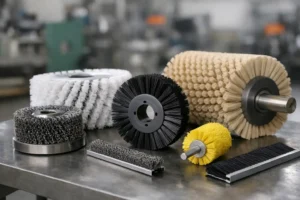

A brush can have the correct outside diameter, core, and filament material yet still perform poorly because the filament packing is wrong. This guide to industrial brush density selection helps maintenance teams, engineers, and buyers specify brushes that produce the required contact without overloading equipment, trapping debris, or wearing out prematurely.
Density is not a cosmetic specification. On a cylindrical brush, strip brush, wheel brush, or brush panel, it affects flexibility, contact pressure, material flow, cleaning action, heat generation, and service life. The right choice starts with the task the brush must perform, then accounts for machine speed, workpiece condition, filament type, and operating environment.
What brush density means in industrial applications
Brush density describes how closely filaments are packed into a brush body. Depending on the product design, it may be controlled by the number of tufts per inch, holes per row, winding pitch, staple spacing, or the amount of filament packed into a strip channel. A denser brush has more filament points contacting the surface. A lower-density brush has more space between those contact points and generally offers greater individual filament movement.
Density should not be confused with filament diameter. A brush may use fine filaments at high density, heavy filaments at lower density, or a combination designed to achieve a specific result. Filament length also changes the working feel of the brush. Long filaments flex more readily, while shorter trim lengths create a firmer working face.
For industrial buyers, density selection is about balancing force and compliance. Too little density may leave contaminants behind, provide insufficient support, or fail to maintain a seal. Too much density can raise motor load, increase friction, mark sensitive surfaces, and prevent debris from clearing effectively.
Start with the required brush action
The application determines whether high, medium, or low density is appropriate. Before requesting a replacement or custom brush, define what the brush is expected to do during each machine cycle.
Cleaning and debris removal
For dry dust, loose chips, light powder, and other free-moving contaminants, a medium or lower density often works better than maximum packing. The spaces between filaments allow particles to move through and away from the contact area. This is particularly relevant for conveyor cleaning, wood dust control, packaging lines, and general industrial housekeeping equipment.
A higher-density brush may be necessary when the contaminant is fine, adhered, or spread across a broad surface. However, the brush must still release material rather than compact it against the workpiece. In wet or oily applications, an overly dense brush can retain fluid and debris, making cleaning less efficient and increasing maintenance requirements.
Surface finishing and deburring
Finishing brushes need consistent contact, but consistency does not always mean maximum density. Abrasive nylon brushes used for edge blending, burr removal, or surface conditioning typically require a density that supports uniform abrasive action without creating excessive heat or an aggressive cut.
Higher density can improve coverage on flat material and stabilize the brush face at production speeds. It can also increase the risk of changing the surface finish, rounding features more than intended, or generating heat on thin sheet and sensitive coatings. A lower density may be preferred for irregular parts, recessed details, or applications where the brush must conform around edges.
Sealing, shielding, and part protection
Strip brushes used for sealing doors, guarding openings, controlling overspray, or reducing dust migration usually need enough density to close the gap without creating excessive drag. The choice depends heavily on the gap size, direction of movement, pressure differential, and the item passing through the opening.
A dense, fine-filament strip brush can form an effective barrier against dust and light particles. For a moving conveyor, roll-up door, or guided product, the filament must flex repeatedly without scuffing surfaces or causing resistance. In these cases, trim length and filament stiffness matter as much as density.
Supporting and guiding sheet material
Brush tables and brush panels for CNC punch presses, laser systems, sheet handling, and fabrication equipment must support material while minimizing scratching and drag. Excessive density can make sheet movement harder, particularly when parts are moved manually or through automated handling. Insufficient density can reduce support, allow vibration, and contribute to surface damage.
For brush table panels, density must be matched to sheet weight, panel layout, brush height, and the type of material being processed. A panel designed for stainless steel sheets may need a different configuration than one used for coated aluminum or painted material. Replacement panels should be measured against the machine’s existing dimensions, mounting features, and support requirements rather than selected by approximate appearance alone.
How filament material changes density decisions
Density cannot be selected separately from filament material. Each material bends, recovers, resists wear, and reacts to chemicals or temperature differently.
Nylon provides good wear resistance and recovery for many cleaning, conveying, and general industrial applications. Polypropylene is often selected where moisture and chemicals are present, including washdown or food-related environments where compatible materials are required. Steel wire, stainless steel wire, and abrasive nylon create more aggressive contact and may require lower density or a longer trim to avoid excessive force.
Natural fibers and softer synthetic filaments may require greater density when a fuller contact face is needed. Conversely, a stiff wire brush at high density can become unnecessarily aggressive, especially on thin metal, coated surfaces, glass-adjacent equipment, or precision components.
Temperature is another practical factor. A brush operating near ovens, heated process equipment, or hot metal needs a filament material that holds its properties at the expected operating temperature. Adding density cannot compensate for a material that softens, melts, becomes brittle, or loses recovery in service.
Evaluate speed, pressure, and contact area together
Brush density is most reliable when evaluated as part of the complete operating condition. A brush that performs well on a slow manual station may run too hot or draw too much power at high RPM. On cylindrical and roller brushes, increased speed amplifies the effect of density because more filament contacts occur over a shorter period.
Contact pressure should come from controlled interference, not from forcing the brush deeply into the workpiece. As a general rule, use the minimum interference needed to achieve the desired cleaning, finishing, sealing, or support result. If the brush must be compressed heavily to work, the design may need a different density, trim length, filament diameter, or core construction.
The width of the contact zone also matters. A narrow contact line concentrates force. A broad contact zone distributes it. For example, a dense cylindrical brush with a short trim may be suitable for a controlled finishing path, while a less dense, longer-trim brush may be better for following uneven surfaces or clearing chips from a complex profile.
Signs that density is wrong
Production teams often identify density problems through performance symptoms rather than specification sheets. Common indicators include inconsistent cleaning, material drag, brush overheating, excessive motor load, premature filament breakage, surface marking, and debris buildup in the brush face.
If a brush leaves a pattern of missed areas, it may need more density, a different filament arrangement, or improved contact alignment. If it pushes debris instead of removing it, the brush may be too dense, too stiff, or rotating in the wrong direction for the application. If a brush wears rapidly at the leading edge, review alignment, pressure, and workpiece presentation before simply increasing filament packing.
For replacement brush programs, compare actual wear patterns with the original brush design. A repeated failure may indicate that the existing specification was only adequate, not properly engineered for the operating conditions.
Information to provide for a custom brush quote
A technical quote is more accurate when the supplier can evaluate density in context. Provide the brush type, overall dimensions, core or backing material, filament material if known, trim length, and the current density or tuft pattern when available. Photos of the existing brush and its mounting location are useful, especially for worn or discontinued replacement parts.
Also include machine make and model, rotational speed or line speed, direction of travel, material being contacted, operating temperature, chemical exposure, and the required result. For brush panels and CNC punch press brush tables, specify panel dimensions, mounting pattern, machine brand, and whether the objective is sheet support, scratch reduction, or replacement of damaged sections.
Cepillos Regios manufactures custom-engineered industrial brush solutions designed for durability, fit, and performance. A custom specification can adjust density alongside filament, trim, core, and mounting details so the brush works with the machine rather than creating another source of downtime.
Frequently asked questions about brush density selection
Does a denser brush always last longer?
Not necessarily. More filaments can distribute wear across a larger contact area, but excessive density may increase friction, heat, and bending stress. Service life depends on the material, speed, pressure, contamination, and how well the brush matches the application.
Can density be changed on an existing replacement brush?
Yes, in many cases. A replacement brush can be manufactured with a revised tuft pattern, winding pitch, or strip fill to address cleaning, support, or wear issues. Dimensions and mounting features should remain compatible with the equipment unless a machine modification is planned.
Is higher density better for brush table panels?
It depends on sheet weight, surface sensitivity, and how the material moves over the table. High density can provide fuller support, but it may also increase drag. The correct design balances support with low-friction handling and protection of the finished surface.
Need a custom industrial brush solution? Request a custom quote from Cepillos Regios based on your machine, dimensions, material, and application. A brush designed around real operating conditions is more likely to protect equipment, maintain product quality, and keep the line moving.