
A cleaning brush that leaves contamination behind, sheds into the process, or damages a product surface is not a minor maintenance issue. It can become a throughput, quality, and sanitation problem within a single shift. Production line cleaning brushes must be matched to the material being removed, the surface being cleaned, line speed, operating temperature, moisture, chemicals, and the geometry of the equipment.
For plant managers, maintenance departments, OEMs, and procurement teams, the right question is not simply, “Which brush fits?” It is, “Which brush will clean effectively without creating another problem?” A properly specified industrial brush helps keep conveyors, rollers, workpieces, dies, sensors, and surrounding equipment operating as intended. A poorly specified brush can cause premature wear, incomplete cleaning, product damage, or frequent replacement.
What Production Line Cleaning Brushes Must Accomplish
Production equipment accumulates far more than visible dust. Depending on the operation, contamination may include metal fines, cutting fluid residue, cardboard fibers, food particles, plastic trim, powder, scale, adhesive buildup, glass dust, wood chips, or abrasive media. Each contaminant behaves differently, and each requires a different combination of filament material, brush density, stiffness, and brush configuration.
The brush must also fit the cleaning task. Some applications need a light sweep to remove loose material from a conveyor or product surface. Others need controlled contact pressure to dislodge compacted debris from rollers, belts, machine guards, or textured components. In surface-sensitive processes, aggressive brushing can leave scratches or alter a finish. In heavy industrial environments, a brush that is too soft may simply bend over contamination instead of removing it.
That is why custom-engineered industrial brush solutions start with the application, not a catalog part number. The goal is consistent cleaning performance that supports production continuity while protecting equipment and finished goods.
Selecting the Right Brush Type for the Line
The most suitable brush construction depends on where it runs, how it contacts the surface, and whether the line requires continuous or intermittent cleaning.
Cylindrical and roller brushes
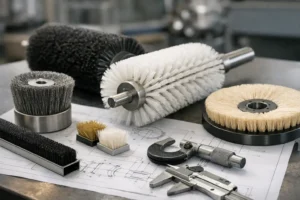
Cylindrical brushes, also called roller brushes, are commonly used where a rotating cleaning action is needed across a belt, sheet, panel, part, or conveyor width. They can remove loose debris, scrub residue, convey parts, or prepare a surface before coating, printing, inspection, or packaging.
Their effectiveness depends on core diameter, overall diameter, face length, mounting method, rotation direction, and filament pattern. A roller brush that is correctly dimensioned but installed with excessive interference can generate heat, wear quickly, and place unnecessary load on bearings or drives. Conversely, insufficient contact may leave debris in place.
Strip brushes
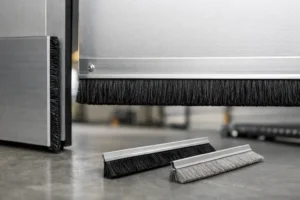
Strip brushes are practical for linear cleaning, wiping, dust control, and sealing tasks. They can be mounted along conveyor edges, above moving materials, around openings, or against rollers and guides. Their metal, plastic, or specialty channels can be cut and formed to suit a machine frame or enclosure.
For many production lines, strip brushes serve two functions at once: they clean light debris while also limiting dust migration into sensitive areas. This is especially useful around packaging equipment, CNC machinery, material-transfer points, and automated work cells.
Wheel and twisted brushes
Wheel brushes concentrate cleaning action in a smaller contact area. They are often used for edges, seams, grooves, holes, and localized buildup where a full-width roller brush would be inefficient. Twisted brushes are suited to tubes, channels, nozzles, threaded components, and confined passages.
These brush types are highly application-specific. Diameter, filament trim, stem or arbor dimensions, and the material being cleaned all matter. Providing a sample part or clear equipment measurements can prevent a replacement brush from being unsuitable after delivery.
Abrasive nylon brushes
When surface preparation or stubborn residue removal is required, abrasive nylon may be appropriate. Filaments containing abrasive grit can remove oxidation, burrs, scale, coatings, and processing residue while conforming better than some rigid abrasive tools.
There is a trade-off. More aggressive abrasive content and stiffer filaments can increase cleaning speed, but they may affect a delicate finish or shorten brush life under high-pressure contact. Testing is often worthwhile for stainless steel, aluminum, coated sheet, glass-adjacent equipment, and other surfaces where appearance and dimensional control matter.
Filament Material Determines More Than Cleaning Power
Bristle material should be selected for the operating environment as carefully as the brush shape. Nylon is widely used for its wear resistance and flexibility, while polypropylene is often chosen for moisture resistance and many wet-cleaning applications. Polyester can perform well where heat and chemical exposure are concerns. Natural fibers may be suitable for light dusting or finish-sensitive work, while wire filaments are used for more aggressive cleaning, deburring, and scale removal.
Filament diameter changes the result as well. Fine filaments create more contact points and are generally better for light dust, powders, and delicate surfaces. Heavier filaments provide greater stiffness for larger debris, compacted material, and demanding scrubbing. Higher brush density can improve coverage, but it may also retain material in wet or sticky applications if the brush is not cleaned regularly.
Food processing adds another layer of requirements. Brush materials, construction, cleanability, and replacement intervals must align with the facility’s sanitation procedures. The right design may prioritize moisture resistance, easy washdown, and reduced opportunities for debris to collect around the core or mounting hardware.
Fit and Machine Compatibility Are Non-Negotiable
A brush can be made from the right material and still fail the application if it does not fit the machine correctly. Production equipment has specific shaft sizes, bore requirements, keyways, mounting holes, core lengths, clearances, and rotation constraints. Replacement brushes should be evaluated against the actual installed component, not only a machine description.
This is particularly relevant for brush tables and brush panels used on CNC punch presses and sheet metal processing equipment. Worn panels can allow finished sheet to drag, scratch, or lose stable support during processing. Replacement brush table panels for Amada, TRUMPF, Salvagnini, Prima Power, Murata, Finn-Power, LVD, Strippit, and similar machines need correct panel dimensions, brush height, density, and base configuration to perform as expected.
When ordering a custom or replacement brush, provide the following information whenever possible:
- Brush type and intended function, such as sweeping, scrubbing, sealing, guiding, or surface protection
- Exact dimensions, including face length, outside diameter, core diameter, bore size, and mounting details
- Filament material, diameter, trim length, and density if known
- Operating conditions, including line speed, temperature, wet or dry exposure, chemicals, and contamination type
- Photos, drawings, part numbers, or a sample of the existing brush
These details reduce back-and-forth during quoting and help the manufacturer identify practical improvements over an existing brush design.
When to Replace Cleaning Brushes
Brush replacement should be based on performance, not just calendar intervals. A brush may need attention when cleaning results become inconsistent, bristles are visibly worn or permanently bent, pressure settings have been increased to compensate for lost contact, debris begins reaching downstream equipment, or operators are spending additional time manually cleaning the line.
Uneven wear deserves investigation. It may indicate misalignment, excessive contact pressure, shaft runout, an uneven conveyor surface, or a brush that is not designed for the actual operating conditions. Replacing the brush without correcting the root cause can lead to the same failure pattern.
Keeping a critical spare brush in inventory is often justified for high-volume or difficult-to-access equipment. The cost of a stocked replacement is usually easier to manage than an unplanned shutdown while a maintenance team searches for a compatible part. For custom components, document dimensions and operating specifications so future replacement orders can move faster.
A Better Sourcing Approach for Industrial Buyers
Industrial brush sourcing works best when buyers treat the brush as a functional machine component rather than a generic consumable. A supplier should be able to discuss core construction, filament selection, brush pattern, mounting compatibility, expected wear conditions, and the application’s actual failure mode.
Cepillos Regios manufactures replacement and custom brush solutions for production equipment, with designs built for manufacturing, cleaning, sealing, and surface-treatment needs. For U.S. manufacturers and industrial operators in Texas, Illinois, Ohio, Michigan, and other production-intensive markets, nearshore manufacturing can support practical lead times and more direct communication when a brush needs to be made to specification.
Frequently asked questions
Can one brush material work across an entire production line?
Sometimes, but not always. A line may use a soft brush for product contact, a stiffer brush for conveyor cleaning, and a strip brush for dust sealing. Combining those roles into one brush material can compromise cleaning effectiveness or surface protection.
Should a cleaning brush contact the surface aggressively?
Not necessarily. The correct interference depends on brush type, filament stiffness, rotational speed, and the surface being cleaned. Too much pressure can damage the brush and equipment; too little can reduce cleaning performance. Adjustment should be based on observed results and manufacturer guidance.
Is a sample required for a custom replacement brush?
A sample is helpful but not always required. Accurate dimensions, photographs, drawings, shaft and mounting details, and a description of the application can be enough to manufacture a suitable replacement. A sample is especially useful when the existing brush has a specialized core or nonstandard pattern.
If cleaning performance is affecting quality, maintenance hours, or line uptime, the brush deserves a closer look before the next replacement order. Request a custom quote from Cepillos Regios based on your machine, dimensions, material, and application, and specify the operating conditions that the brush must handle.