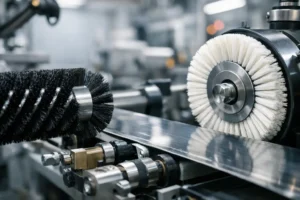

A brush that works well in a packaging line can fail quickly in a steel plant. The reason is simple: brushes by industry are not interchangeable when operating conditions, contamination, surface sensitivity, line speed, and exposure to heat or chemicals all change the job.
For plant managers, OEMs, and maintenance teams, the right industrial brush is less about catalog category and more about application fit. A sealing brush on a conveyor guard, a cylindrical brush for cleaning sheet metal, and a brush table panel for a CNC punch press may all be called industrial brushes, but they solve very different production problems. When the brush is wrong, the result is usually visible fast – product marking, poor cleaning, dust leakage, accelerated wear, or unplanned replacement.
Why brushes by industry matter
Industrial buyers usually start with the task: clean, seal, guide, transport, finish, or protect. That is the right starting point, but it is only part of the decision. The industry tells you what the brush must survive.
In food processing, washdown and hygiene standards may drive material selection. In metal fabrication, abrasion, burrs, coolant, and impact resistance matter more. In glass or solar applications, surface protection becomes critical because even minor scratching can create reject rates. In automotive and general manufacturing, repeatability and fit matter because the brush has to perform consistently across long production runs.
That is why custom-engineered industrial brush solutions are often the better choice than generic replacements. The operating environment changes the ideal filament, core, density, trim length, mounting method, and overall construction.
Common industrial brush functions across sectors
Even though applications vary widely, most industrial brushes are built for a few core functions. Some are designed for cleaning debris, dust, scale, chips, or residue from parts and equipment. Others are built for sealing gaps around machinery, doors, conveyors, enclosures, or moving assemblies. Many are used for surface treatment, whether that means deburring, light abrasion, polishing, washing, or product guidance.
There are also brushes designed primarily to protect material handling surfaces. Brush tables and brush panels are a good example. In CNC punching, sheet metal processing, and fabrication environments, these brushes help support material while reducing contact damage to finished surfaces.
The point is not just what the brush does, but what failure looks like if the brush is underspecified. A poor seal lets in dust. An overly aggressive filament mars the product. A low-density cleaning brush leaves debris behind. A brush table with the wrong height or pattern can interfere with sheet movement and part quality.
Brushes by industry: what changes from one sector to another
Metal fabrication and CNC equipment
Metal fabrication is one of the clearest examples of why exact fit matters. Brush tables, brush panels, roller brushes, and cylindrical brushes are often exposed to sharp edges, metal fines, oil, and continuous contact. Here, durability and dimensional accuracy are not optional.
For CNC punch press brush panels, the right replacement depends on machine brand, panel layout, brush height, density, and the type of sheet being processed. If the panel sits too high, it can affect material feed. If it sits too low, the sheet loses support. In many shops, replacement timing is tied directly to part finish quality and machine consistency, not just visible wear.
This is also an industry where nearshore supply and dependable lead times matter. Plants in Texas, Illinois, Ohio, and Michigan cannot afford long delays on replacement and custom brush solutions for production equipment.
Food processing and packaging
Food and packaging operations often need brushes built for cleanliness, repeatable performance, and compatibility with washdown or sanitary environments. Strip brushes and sealing brushes are common for guarding, containment, and debris control. Roller and cylindrical brushes may be used in cleaning, conveying, sorting, or product handling.
The trade-off here is often between cleaning aggressiveness and product protection. A brush that cleans equipment well may be too stiff for direct product contact. Material choice matters, and so does moisture exposure, temperature range, and chemical compatibility if sanitation procedures are frequent.
Packaging lines also put a premium on uptime. If a brush is slightly off in dimension or mounting, installation time increases and line restarts take longer than they should.
Steel and heavy industrial environments
Steel processing and other heavy-duty operations usually call for brushes manufactured for demanding industrial applications. Heat, scale, abrasive dust, heavier loads, and high line speeds push brush materials harder than many other sectors.
Wheel brushes, roller brushes, and abrasive nylon brushes may be used for cleaning, edge conditioning, scale removal, or surface preparation. In these settings, over-specifying can sometimes be justified because replacement labor and production interruptions often cost more than the brush itself. Still, too aggressive a filament can shorten the life of adjacent machine components or affect the workpiece surface, so the strongest option is not always the right one.
Glass, solar, and sensitive-surface production
In glass and solar manufacturing or maintenance, surface contact has to be controlled carefully. The brush needs to clean or guide without scratching, hazing, or leaving inconsistent marks.
This is where filament material, tip finish, density, and brush speed all work together. A brush that performs well on a dirty, durable substrate may be completely unsuitable for coated glass or solar panels. These applications usually benefit from design review based on actual operating conditions rather than selecting a standard part by appearance alone.
Textile, wood, and ceramics
These industries often use brushes for cleaning, dust control, guiding, finishing, and static reduction support. The operating environment can be deceptively harsh. Fine dust, fibers, abrasive particles, and continuous motion all affect wear patterns.
Strip brushes and sealing brushes are common where containment matters. Roller and twisted brushes may be better for cleaning or processing parts with irregular geometry. In wood and ceramics, the right balance between stiffness and flexibility can determine whether the brush improves finish quality or creates secondary defects.
How to choose the right brush for the application
The fastest way to choose the wrong brush is to buy only by shape. Cylindrical, strip, wheel, twisted, and panel brushes each serve clear functions, but geometry alone does not solve the application.
Start with the machine and the process. What material is being handled? Is the brush cleaning, sealing, supporting, or abrading? What are the operating speed, temperature, contamination type, moisture level, and expected service life? If the brush is a replacement part, dimensional fit has to be exact, including mounting details, core size, trim length, and overall assembly requirements.
Next, consider what you are optimizing for. Some buyers prioritize longest wear life. Others need better finish protection, easier changeout, or faster availability. Those priorities can point to different brush designs. It depends on whether downtime cost, surface quality, sanitation, or maintenance frequency is driving the purchase.
When custom manufacturing makes more sense than standard stock
Standard brushes have a place, especially when the application is straightforward and dimensions are common. But many production environments are not straightforward. OEM equipment modifications, older machinery, unusual mounting patterns, nonstandard lengths, and industry-specific materials often make off-the-shelf parts a compromise.
Custom-engineered industrial brush solutions are usually the better path when the brush directly affects machine performance, product quality, or uptime. A custom part can be designed for durability, fit, and performance around the actual operating conditions instead of forcing the process to adapt to an approximate replacement.
That is especially true for brush tables, brush panels, sealing assemblies, and specialty rollers where small dimensional errors create larger operating problems.
What to provide when requesting a quote
A useful quote request should include the machine type, application, dimensions, brush style, and the material being processed. Photos of the current brush and mounting area help. If the existing brush failed early, that detail matters too, because wear pattern usually says something about pressure, speed, contamination, or misalignment.
For replacement parts, buyers should provide as much exact information as possible: outside diameter, inside diameter, overall length, trim length, filament type, core material, and any shaft, channel, or fastening details. For custom builds, production goals matter just as much as measurements. The more clearly the application is defined, the better the brush can be matched to the job.
A practical partner matters as much as the brush
Industrial buyers are rarely looking for just a part number. They need a supplier that understands machine compatibility, material selection, and how brush design affects line performance. That is where an experienced manufacturer adds value – not by overselling a product, but by helping prevent the common problems that come from poor fit, wrong filament choice, or slow replacement cycles.
For U.S. manufacturers and industrial operators, especially in production-heavy states where downtime has immediate cost, the right supplier should be able to support both standard replacement needs and made-to-spec solutions. Cepillos Regios focuses on that kind of support, with custom brush manufacturing built around real machine dimensions, application demands, and lead-time pressure.
If you are sourcing brushes by industry, the most useful question is not which brush is most popular. It is which brush is built for your machine, your environment, and the result your production line has to deliver every shift.